
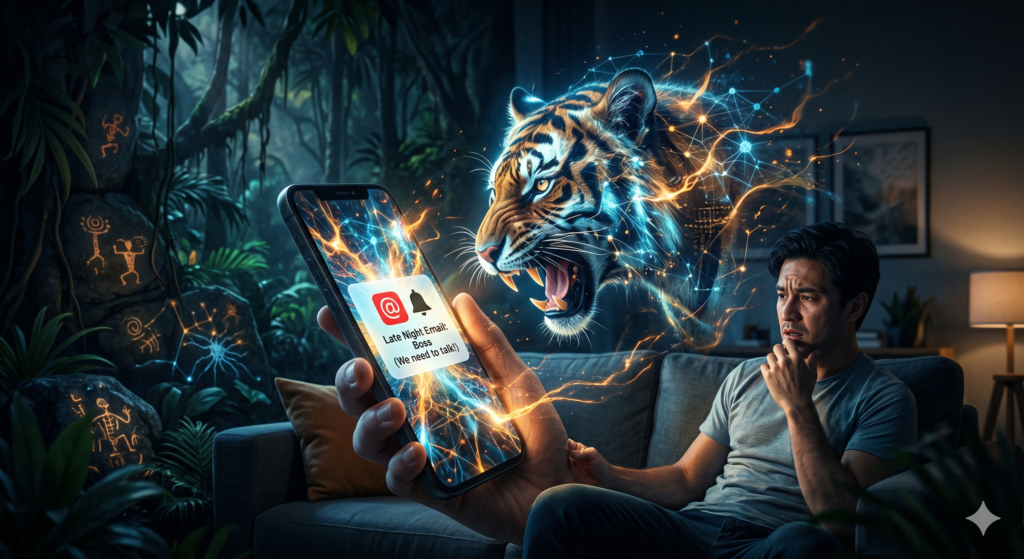
Imagine walking through a dense, primaeval jungle thousands of years ago. Suddenly, the bushes rustle, and a tiger steps into your path. In a fraction of a second, your amygdala-your brain’s ancient threat detector-fires an emergency alarm. Adrenaline and cortisol flood your bloodstream. Your heart races to pump blood to your muscles; your breathing turns shallow to maximise oxygen; your logical mind shuts down, focusing entirely on survival. You fight or flee. Once the danger passes and you are safe with your tribe, your parasympathetic nervous system lowers your heart rate and returns your body to a peaceful baseline.
Now, fast forward to the modern world. You’re sitting comfortably at home when you pick up your phone and see a late-night email from your boss: “We need to talk first thing tomorrow.” Or, perhaps, a passive-aggressive text from your partner, followed by silence. Instantly, that same suffocating knot of panic tightens in your chest. Your heart rate spikes, your palms sweat, and anxiety washes over you.
There is no physical tiger in the room. You are completely safe from physical harm. Yet, biologically, your body is reacting as if you are being hunted. Why does the modern digital world feel like a constant threat to our sanity?
The Neurobiological Mismatch
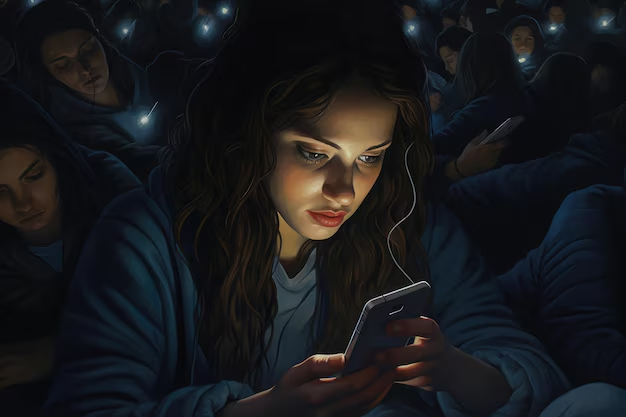
To understand digital anxiety, we must look at a fundamental concept in evolutionary biology known as evolutionary mismatch. This occurs when a species’ biological traits, which evolved over hundreds of thousands of years to survive in one specific environment, are suddenly placed into a completely different environment. Human biological hardware has not changed significantly in over two hundred thousand years. Our brains were elegantly engineered for a slow-paced, analog world where threats were physical, immediate, and short-lived.
Today, we are forcing that exact same ancient hardware to run a hyper-connected, light-speed digital world. Your brain cannot tell the difference between a real, physical predator and a digital notification on a piece of glass. To your nervous system, a threat to your social standing, financial security, or professional stability triggers the exact same chemical cascade as a wild animal trying to end your life.
But here lies the modern tragedy. When a primitive human encountered a tiger, they ran or fought. This intense physical exertion acted as a natural release valve, burning off the adrenaline and cortisol. Today, when your boss sends an intimidating email, you cannot physically run away, and you cannot punch your laptop screen. Instead, you sit perfectly still at your desk or in your bed. You look calm on the outside, but on the inside, those toxic stress hormones have nowhere to go. They simply circulate through your body, keeping your nervous system trapped in a state of chronic, low-grade hyper-vigilance.
Screen Time, Dopamine Looping, and Social Exile
This evolutionary mismatch goes far deeper than just stress notifications; it alters the very chemistry of our focus and human connection. Our brains are naturally wired to seek information and rewards, a survival mechanism driven by dopamine. In nature, rewards took immense effort to find. In the digital jungle, however, platforms are intentionally engineered to hijack this system. Every endless scroll, every notification ping, and every variable reward on social media feeds your brain cheap, effortless dopamine. Over time, your neural pathways adapt to this hyper-stimulation. Real life begins to feel painfully slow, shattering your attention span and leaving behind a heavy, cloudy sensation often described as digital brain fog.
Furthermore, we are deeply social creatures. For millennia, human beings relied on physical proximity, eye contact, and the safe cadence of a human voice to co-regulate their nervous systems. True connection requires biological resonance. Today, we attempt to replace this profound biological need with text messages and curated photo grids. When that connection feels fragile-when someone leaves us on “read” or suddenly stops replying—our ancient brain panics. In a prehistoric tribe, being ignored or isolated by the group meant literal death because you could not survive alone. Today, your brain interprets a lack of digital validation as social exile, triggering a profound, underlying hum of loneliness and rejection.
The Power of Practical Realignment
Understanding the science behind your anxiety changes everything. It proves that you are not weak, lazy, or broken. Your anxiety is simply a healthy, ancient brain doing exactly what it was designed to do, which is trying to protect you in an environment it doesn’t understand. We cannot destroy our smartphones or completely run away from the modern digital landscape. However, we can use targeted, evidence-based tools to gently retrain our nervous systems and bridge this biological gap.
Conclusion: Becoming the Architect
Becoming the architect of your life requires neural realignment-the conscious decision to stop reacting to digital noise and start intentionally designing your environment. By applying these science-backed habits, you aren’t just changing your routine; you are physically rewiring your brain’s response to the modern world. Take that first step today: align your daily system with your true values, and watch how your mind begins to transform.
